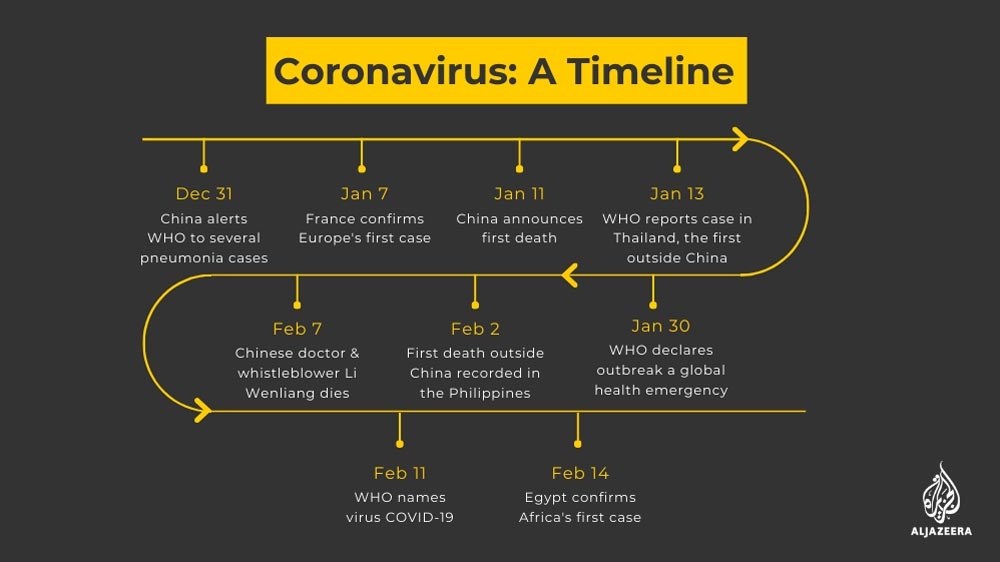
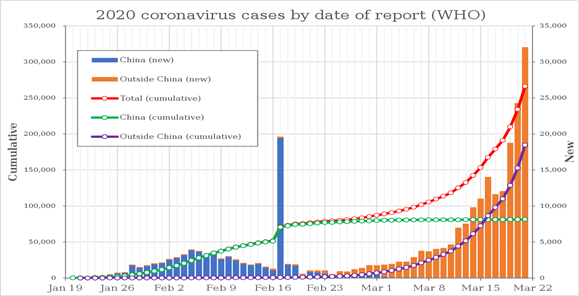
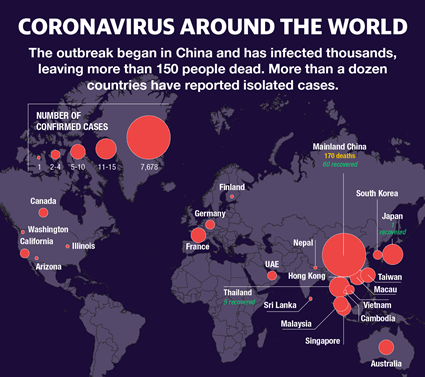
Corona virus (COVID-19) is the ongoing pandemic that had begun in 2019. However, it was declared as a pandemic on 11th March, 2020 by WHO. It generated in Wuhan in China and has spread exponentially throughout the world and has been registered in 180 territories and countries globally. Italy, South Korea and Iran are few of the most effected regions. As of 22nd March, more than 308,000 cases, more than 13,000 deaths and 95,000 recoveries have been reported. This has resulted in widespread panic, shutting down in businesses and breakdown of economy, curfews being imposed and self-quarantining of a huge number of people. In India, until now there have been around 315-320 infected individuals. Some precautionary measures that had been prescribed to everyone for safety like- social distancing, maintaining cleanliness and basic hygiene, usage of alcohol-based hand sanitizers and that people with cough and cold should wear masks.
GOVERNMENT MEASURES
CHINA- The team began in Beijing and then split into two groups that, all told, travelled to Shenzhen, Guangzhou, Chengdu, and the hardest hit city, Wuhan. They visited hospitals, laboratories, companies, wet markets selling live animals, train stations, and local government offices. They wanted to segregate the mildly sick people to stop the spread of the virus. But, at the fever clinic they found that most of the people tested with mild fever tested negative of the virus (0.14%). The most dramatic and controversial measure was the lockdown of Wuhan and nearby cities in Hubei province, which has put at least 50 million people under a mandatory quarantine since 23 January. This effectively prevented further exportation of infected individuals to the rest of the country of China. Chinese authorities also built two dedicated hospitals in Wuhan in just over 1 week. Health care workers from all over China were sent to the outbreak’s centre. The government launched an unprecedented effort to trace contacts of confirmed cases. In Wuhan alone, more than 1800 teams of five or more people traced tens of thousands of contacts.
Aggressive “social distancing” measures implemented in the entire country included cancelling sporting events and shuttering theatres. Schools extended breaks that began in mid-January for the Lunar New Year. Many businesses closed shop. Anyone who went outdoors had to wear a mask. Two widely used mobile phone apps, AliPay and WeChat—which in recent years have replaced cash in China—helped enforce the restrictions, because they allow the government to keep track of people’s movements and even stop people with confirmed infections from traveling. The mission member Gabriel Leung, dean of the Li Ka Shing Faculty of Medicine at the University of Hong Kong claimed that everyone has a traffic light system. Colour codes on mobile phones in which green, yellow, or red designate a person’s health status to let guards at train stations and other checkpoints know who to let through. As public life reduced, infected people rarely spread the virus to anyone but members of their own household, Leung claimed. Once all the people in an apartment or home were exposed, the virus had nowhere else to go and chains of transmission ended. In sum, Leung opined, there was a combination of “good old social distancing and quarantining very effectively done because of that on-the-ground machinery at the neighbourhood level, facilitated by AI big data.”
ITALY– Italian authorities have implemented draconian measures to try to halt the coronavirus outbreak in the north of the country, including imposing fines on anyone caught entering or leaving outbreak areas, as a third person was confirmed to have died on Sunday. Police are patrolling 11 towns – mostly in the Lombardy region, where the first locally transmitted case emerged – that have been in lockdown since Friday night. The latest victim died in the Lombardy city of Crema. Austria suspended train services over the Alps to Italy for about four hours late on Sunday before restarting them after two travellers tested negative for coronavirus. About 50,000 residents in the towns under lockdown have been told to stay home and avoid social contact, while schools, shops and businesses – apart from chemists – have been closed and festivities and sporting events including Serie A football matches and the final two days of the Venice carnival have been cancelled. Schools and universities will also be closed for at least a week in Lombardy, Veneto, Emilia-Romagna and Piedmont, while similar measures have been taken in Liguria and Alto Adige. Milan fashion week has also been affected by the outbreak, the collection would be shown to an empty room. On 11 March that the lockdown would be tightened, with all commercial and retail businesses except those providing essential services, like grocery stores, food stores, and pharmacies, closed down. On 19 March, with over 35,000 confirmed cases and nearly 3,000 deaths from the disease, Conte stated that the lockdown would likely be extended past its initial deadline of 3 April. Luigi Di Maio, the Minister of Foreign Affairs, has said that the lockdown has been necessary for Italy. The Italian authorities established sanctions for those who do not obey the orders, even those who, having symptoms of the virus, expose themselves in public places, being considered a threat of intentional contagion. On 21 March, the Prime Minister Conte announced a further enlargement of the lockdown, by shutting down all non-necessary businesses and industries, after a rise in the number of cases and deaths in the previous days, and after multiple institutions – including trade unions, mayors, and regional presidents – asked for a generalised shutdown of the Italian production system.
OTHER HOTBEDS- Iran reported its first confirmed cases of SARS-CoV-2 infections on 19 February in Qom, where, according to the Ministry of Health and Medical Education, two people had died later that day. Early measures announced by the government included the cancellation of concerts and other cultural events, sporting events, and Friday prayers, universities, higher education institutions and schools. Iran allocated five trillion rials to combat the virus. Plans to limit travel between cities were announced in March. Shia shrines in Qom remained open to pilgrims until 16 March 2020. Iran became a centre of the spread of the virus after China.
The 2019–20 coronavirus pandemic was confirmed to have spread to Spain on 31 January 2020, when a German tourist tested positive for SARS-CoV-2 in La Gomera, Canary Islands. As of 22 March 2020, there have been 28,603 confirmed cases with 2,575 recoveries and 1,724 deaths in Spain according to authorities.
On 1 February 2020, Australia banned the entry of foreign nationals from mainland China, and ordered its own returning citizens from China to self-quarantine for 14 days. On 1 March, Australia subsequently imposed a travel ban on Iran, South Korea (5 March), and finally Italy (11 March). On 22 March 2020, the State Governments of New South Wales and Victoria reacted to the pandemic by enforcing mandatory closures of non-essential services (such as bars, clubs, restaurants, gyms and other leisure venues), while the Governments of Western Australia and South Australia enacted border closures. A social distancing rule of 4 square metres per person in any enclosed space was enforced by the Australian Government on 21 March.
As a result of the outbreak, many countries and regions including most of the Schengen Area, Armenia, Australia, India, Iraq, Indonesia, Kazakhstan, Kuwait, Malaysia, Maldives, Mongolia, New Zealand, Philippines, Russia, Singapore, Sri Lanka, Taiwan, Vietnam, and the United States have imposed temporary entry bans on Chinese citizens or recent visitors to China, or have ceased issuing visas and re-imposed visa requirements on Chinese citizens. Samoa even started refusing entry to its own citizens who had previously been to China, attracting widespread condemnation over the legality of the decision. The European Union rejected the idea of suspending the Schengen free travel zone and introducing border controls with Italy, which has been criticized by some European politicians. After some EU member states announced complete closure of their national borders to foreign nationals. Saudi Arabia has temporarily banned foreigners from entering Mecca and Medina, two of Islam’s holiest pilgrimage sites, to prevent the spread of coronavirus in the Kingdom. The United States suspended travel from the Schengen Area and later the Common Travel Area. Many countries then started closing their borders to virtually all non-citizens or non-residents in rapid succession, including India, Slovakia, Denmark, Poland, Lithuania, Oman and Russia.
Owing to the effective quarantine of public transport in Wuhan and Hubei, several countries have planned to evacuate their citizens and diplomatic staff from the area, primarily through chartered flights of the home nation that have been provided clearance by Chinese authorities. Canada, the United States, Japan, India, France, Australia, Sri Lanka, Germany and Thailand were among the first to plan the evacuation of their citizens. Pakistan has said that it will not be evacuating any citizens from China. On 7 February, Brazil evacuated 34 Brazilians or family members in addition to four Poles, a Chinese and an Indian citizen. Brazilian citizens who went to Wuhan were quarantined at a military base near Brasília. On the same day, 215 Canadians (176 from the first plane, and 39 from a second plane chartered by the US government) were evacuated from Wuhan, China, to CFB Trenton to be quarantined for two weeks.
Australian authorities evacuated 277 citizens on 3 and 4 February to the Christmas Island Detention Centre which had been “repurposed” as a quarantine facility, where they remained for 14 days. A New Zealand evacuation flight arrived at Auckland on 5 February; the passengers (including some from Australia and the Pacific) were quarantined in a naval base at Whangaparoa north of Auckland. The United States announced that it would evacuate Americans aboard the cruise ship Diamond Princess. On 21 February, a plane carrying 129 Canadian passengers evacuated from Diamond Princess landed in Trenton, Ontario. The Indian government has scheduled its air force to evacuate its citizens from Iran.
HEALTH ORGANISATION
On 5 February, the Chinese foreign ministry stated that 21 countries (including Belarus, Pakistan, Trinidad and Tobago, Egypt and Iran) had sent aid to China. The US city of Pittsburgh announced plans to send medical aid to Wuhan, which is its sister city. The University of Pittsburgh Medical Center (UPMC) also announced plans to provide help. Some Chinese students at other American universities have also joined together to help send aid to virus-stricken parts of China, with a joint group in the Greater Chicago Area reportedly managing to send 50,000 N95 masks and 1,500 protection suits to hospitals in the Hubei province on 30 January. The humanitarian aid organization Direct Relief, in co-ordination with FedEx transportation and logistics support, sent 200,000 face masks along with other personal protective equipment, including gloves and gowns, by emergency airlift to the Wuhan Union Hospital who requested the supplies, by 30 January. The Gates Foundation stated on 26 January that it would donate US$5 million in aid to support the response in China which will be aimed at assisting “emergency funds and corresponding technical support to help front-line responders”. On 5 February, Bill and Melinda Gates further announced a US$100 million donation to the WHO, who made an appeal for funding contributions to the international community the same day. The donation will be used to fund vaccine research and treatment efforts along with protecting “at-risk populations in Africa and South Asia.”
Other countries have also announced aid efforts. Malaysia announced a donation of 18 million medical gloves to China. The Philippine Red Cross also donated $1.4 million worth of Philippine-made face masks, which were shipped to Wuhan. Turkey dispatched medical equipment, and Germany delivered various medical supplies including 10,000 Hazmat suits. On 19 February the Singapore Red Cross announced that they will send $2.26 million worth of aid to China, consisting of protective material and training.
WORLD HEALTH ORGANISATION– On 23 January, in reaction to the central authorities’ decision to implement a transportation ban in Wuhan, WHO representative Gauden Galea remarked that while it was certainly not a recommendation the WHO has made it was also a very important indication of the commitment to contain the epidemic in the place where it is most concentrated.
On 30 January, following confirmation of human-to-human transmission outside China and the increase in the number of cases in other countries, the WHO declared the outbreak a Public Health Emergency of International Concern (PHEIC), the sixth PHEIC since the measure was first invoked during the 2009 swine flu pandemic.
On 5 February, the WHO appealed to the global community for a $675 million contribution to fund strategic preparedness in low-income countries, citing the urgency to support those countries which “do not have the systems in place to detect people who have contracted the virus, even if it were to emerge.” On 11 February, the WHO in a press conference established COVID-19 as the name of the disease. On the same day, Tedros stated that UN Secretary-General António Guterres had agreed to provide the “power of the entire UN system in the response.” A UN Crisis Management Team was activated as a result, allowing co-ordination of the entire United Nations response, which the WHO states will allow them to “focus on the health response while the other agencies can bring their expertise to bear on the wider social, economic and developmental implications of the outbreak. On 14 February, a WHO-led Joint Mission Team with China was activated to provide international and WHO experts to touch ground in China to assist in the domestic management and evaluate “the severity and the transmissibility of the disease” by hosting workshops and meetings with key national-level institutions to conduct field visits to assess the impact of response activities at provincial and county levels, including urban and rural settings.
COMPANIES
How companies are helping their staff to cope with the pandemic situation.
Companies like Microsoft, Google, Amazon, Alphabet, Forbes, LinkedIn, OneDrive, Starbucks, Dolce &Gabbana, Apple, Uber, Walmart, Disney, etc., have stopped their business as much as possible. However, they are continuing to reimburse their employees with their salary. They have helped small businesses and donated huge sums for the safety of their vendors and other internal stakeholders. Dolce & Gabbana have announced that it has partnered with Humanitas University to fund a coronavirus research project. Starbucks has extended its mental health benefits. In partnership with Lyra Health, Starbucks is offering its partners personalized, confidential mental health care, 20 free in-person or video sessions every year for partners and each of their eligible family members, online scheduling with most providers available within two weeks, and access to a provider network of mental health therapists and coaches.
This is how most companies are giving back to the society which is responsible for running their business. One could consider this as a CSR activity but at this point it seems like the of the hour.
 BLOGBLOG